
Candyland KYC: verification documents and withdrawal checks
 Available in GB
Candyland can require identity verification before or around withdrawals. Candyland’s banking information is conditional: for certain alternative-payment users, the banking page lists an ID or passport copy and a recent utility bill.
Candyland’s banking information does not state a fixed KYC processing time, so document verification is kept separate from the casino’s withdrawal-processing wording.
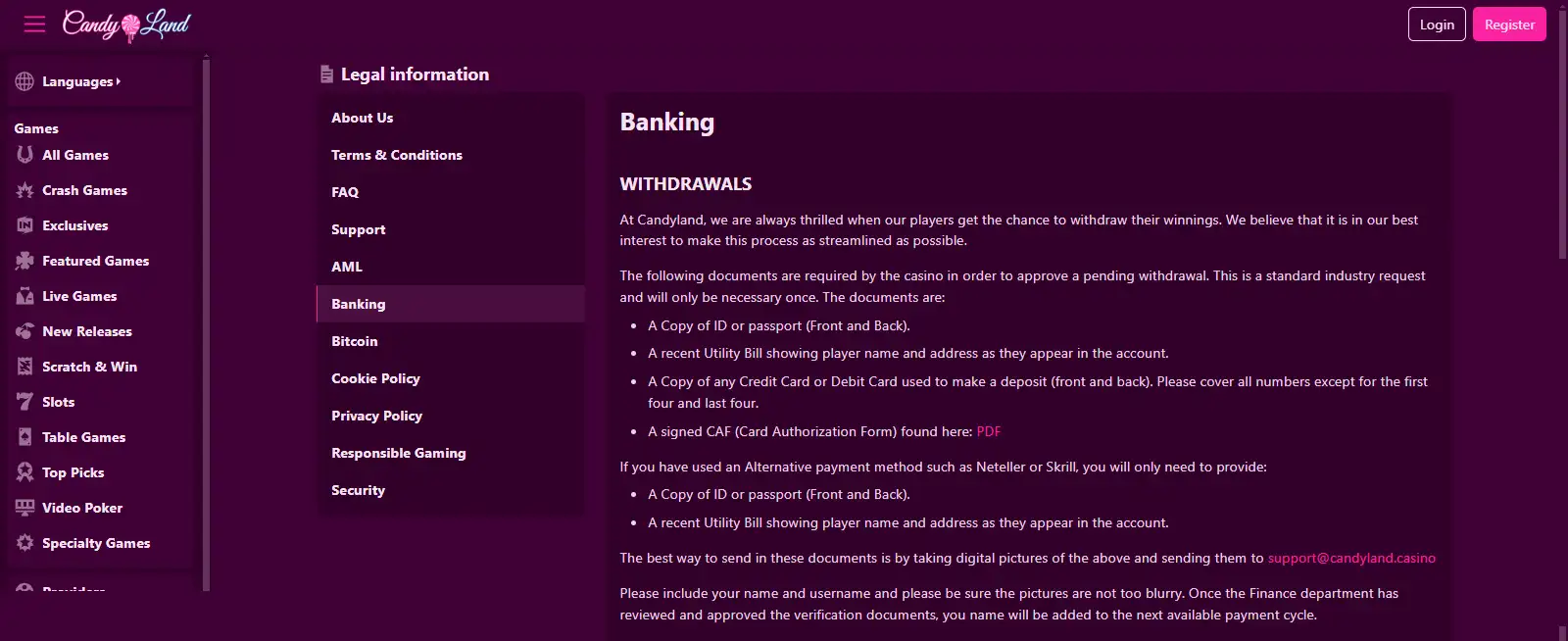
Table of Contents
- When Candyland can request identity verification
- The published document example is conditional
- What is intentionally not stated as a universal requirement
- How to prepare documents without assuming extra requirements
- KYC timing is not the same as withdrawal processing time
- A practical verification sequence
- Why KYC matters to the withdrawal decision
- What can vary in Candyland verification
- How to separate a document request from a payout promise
- What a conditional utility-bill requirement means
- Why accurate account details reduce avoidable verification friction
- Using official support for a verification question
- Related Candyland checks
When Candyland can request identity verification
Candyland may require identity verification documents before or around withdrawals. The available Candyland banking information does not show that every account is checked at the same moment, so KYC should be treated as a conditional account check rather than a guaranteed registration step. A player can therefore reach a withdrawal stage and then be asked to provide documents before the payout process continues.
Candyland also states that players under 18, or below the legal gambling age in their jurisdiction, may not play. Identity verification can support account and age controls, but Candyland does not publish a fixed KYC schedule in its current banking information.
The published document example is conditional
Candyland’s published banking example is narrow. For certain alternative-payment users, Candyland’s banking page lists a copy of an ID document or passport and a recent utility bill. The wording applies to an alternative-payment case rather than every account and payment method.
- ID or passport: Candyland lists a copy of an identity document or passport for the conditional alternative-payment case.
- Recent utility bill: Candyland lists a recent utility bill as the address document in that same conditional case.
Those two items should not be expanded into a permanent card, wallet or crypto checklist unless Candyland expressly applies it more broadly. If Candyland asks for a different document in the authenticated account, follow the current request, but do not assume that a request made to one payment case applies to every player.
What is intentionally not stated as a universal requirement
Candyland does not publish a universal card-document set, a permanent payment-authorisation form requirement or a fixed list for every deposit route. It also does not state an exact KYC processing time. Those details can change and depend on the account, so follow the current Candyland request for the specific case.
That boundary is useful for readers because it prevents a conditional document instruction from becoming a false promise about what will happen to a different account. The reliable statement is narrower: Candyland can request verification before or around withdrawals, and certain alternative-payment users are listed as needing an ID or passport plus a recent utility bill.
How to prepare documents without assuming extra requirements
Even when the operator’s requested list is short, document quality can affect whether the information can be checked. Use complete, readable images of the documents Candyland actually requests. Avoid blur, glare and cropped edges that hide names, dates or address details needed for the check. Make sure the personal information visible on the submitted document is consistent with the account information you entered.
Do not send additional sensitive financial documents simply because an old guide says they are standard. Start with the current request shown in the account or given through the official support route. If the request changes, keep a copy of the message so you know exactly which version of the instruction you followed.
Keeping a submission record is also useful. Note the date the request arrived, what documents were requested, when they were sent and whether Candyland asked for a replacement. This does not create a processing-time guarantee, but it makes it easier to separate a verification stage from later operator processing if a withdrawal takes longer than expected.
KYC timing is not the same as withdrawal processing time
Candyland’s published withdrawal wording says processing can take up to 14 business days, with crypto potentially faster. That is a withdrawal-processing fact, not a fixed KYC turnaround. Do not convert the 14-business-day figure into a promise that document review itself will take the same amount of time.
The distinction matters because a payout can contain more than one stage. A verification request can be pending before operator processing is complete, and payment-provider settlement can occur after the casino releases funds. When asking support about a delay, identify the stage: is Candyland waiting for documents, reviewing the account, processing the withdrawal, or has the payment already been released to the provider?
A practical verification sequence
- Read the exact request. Confirm which documents Candyland is asking for in your case instead of starting from a generic online checklist.
- Check that the request is conditional to your payment case. Candyland’s published conditional list applies to certain alternative-payment users, not universally.
- Match your account information. Use documents that reflect the same identity and address details you supplied to the account where applicable.
- Make the files readable. Submit clear, complete images and avoid missing edges or unreadable text.
- Keep the request and submission record. Save the instruction, the submission date and any follow-up response.
- Ask about the stage, not only the elapsed time. If a withdrawal is pending, establish whether verification or payout processing is the current blocker.
Why KYC matters to the withdrawal decision
Verification can affect when a withdrawal moves forward, so it is worth understanding the requirements before depositing. That does not mean every withdrawal will be delayed or that every player receives the same document request. It means a player should be prepared for identity checks and should avoid creating account-detail inconsistencies that can make a later request harder to resolve.
The withdrawal plan should also stay separate from the deposit-method decision. Candyland supports cards, selected wallets or vouchers and Bitcoin, but payment availability can depend on cashier and country. A method being available to deposit does not tell you which KYC request will apply or how the payout route will be processed.
What can vary in Candyland verification
- Do not assume every player receives the same document list.
- Do not assume a fixed KYC turnaround when Candyland does not state an exact KYC time.
- Do not assume a payout is guaranteed immediately after documents are submitted.
- Do not turn one payment method’s requirements into rules for every cashier option.
- Do not treat the 14-business-day withdrawal-processing wording as a KYC processing promise.
The practical approach is to keep the current account request, conditional document requirements and published withdrawal timing as separate pieces of information.
How to separate a document request from a payout promise
A request for identity documents tells you that Candyland is checking the account. It does not by itself say when the withdrawal will be released, what payment-provider settlement will take, or that approval is guaranteed. These are separate questions: KYC can occur before or around a withdrawal, while Candyland’s withdrawal processing wording is up to 14 business days with crypto potentially faster.
If a payout is pending, use the account status and support response to identify which stage is active. A document request should be answered as a document request; a processing-time question should be asked as a processing-time question. Combining them into one assumed deadline creates a promise Candyland does not make.
What a conditional utility-bill requirement means
Candyland’s alternative-payment example includes a recent utility bill showing the account holder’s identity and address. The word “conditional” is important. It means this document is listed for the stated payment case, not that Candyland always asks every player for a utility bill.
If your authenticated account requests a different address document, follow that current instruction rather than forcing the published example onto your case. Use the published example only as a guide and follow the account-level instruction for any case-specific request.
Why accurate account details reduce avoidable verification friction
Candyland’s age rule and KYC requirement both make identity data relevant. Entering accurate personal information at registration gives the later verification request a consistent account record to compare against. That does not guarantee approval or a faster payout, but it removes a self-created mismatch between the account and the documents being used.
If information has changed, use the official support route to ask how the account should be updated before sending documents that show a different name or address. Keep the response with the verification record so the reason for the difference is documented.
Using official support for a verification question
If a document request is unclear, ask Candyland support which item is required for the account and payment case shown. Confirm the requirement before sending anything beyond the documents specifically requested for that account. Keep the response with the request. That preserves a direct account-level instruction without turning one user’s document set into a universal rule for every Candyland player.
Related Candyland checks
- Candyland UK review – the wider UK-facing product and regulatory context.
- Candyland registration – the account-creation stage that comes before verification.
- Candyland withdrawals – the payout stages and processing-time details.
- Candyland safety – support, identity checks and practical trust checks.
- Candyland payments – the cashier categories and deposit context.
Written by the editors at Candyland Casino 2.