Candyland Casino licence in the UK: UKGC status and Curaçao position
 Available in GB
Candyland, candyland.casino and the operator name SSC Entertainment N.V. do not appear in the UK Gambling Commission’s downloadable business, trading-name or domain datasets. In Great Britain, an online casino serving consumers needs the relevant Gambling Commission operating licence. Candyland has separately stated that it operates under Curaçao licensing jurisdiction, but Candyland does not state a current Curaçao Gaming Authority licence number or domain certificate.
The UKGC result is directly relevant to Great Britain. Northern Ireland has a different gambling-law framework, and technical account access is not the same thing as regulatory authorisation.
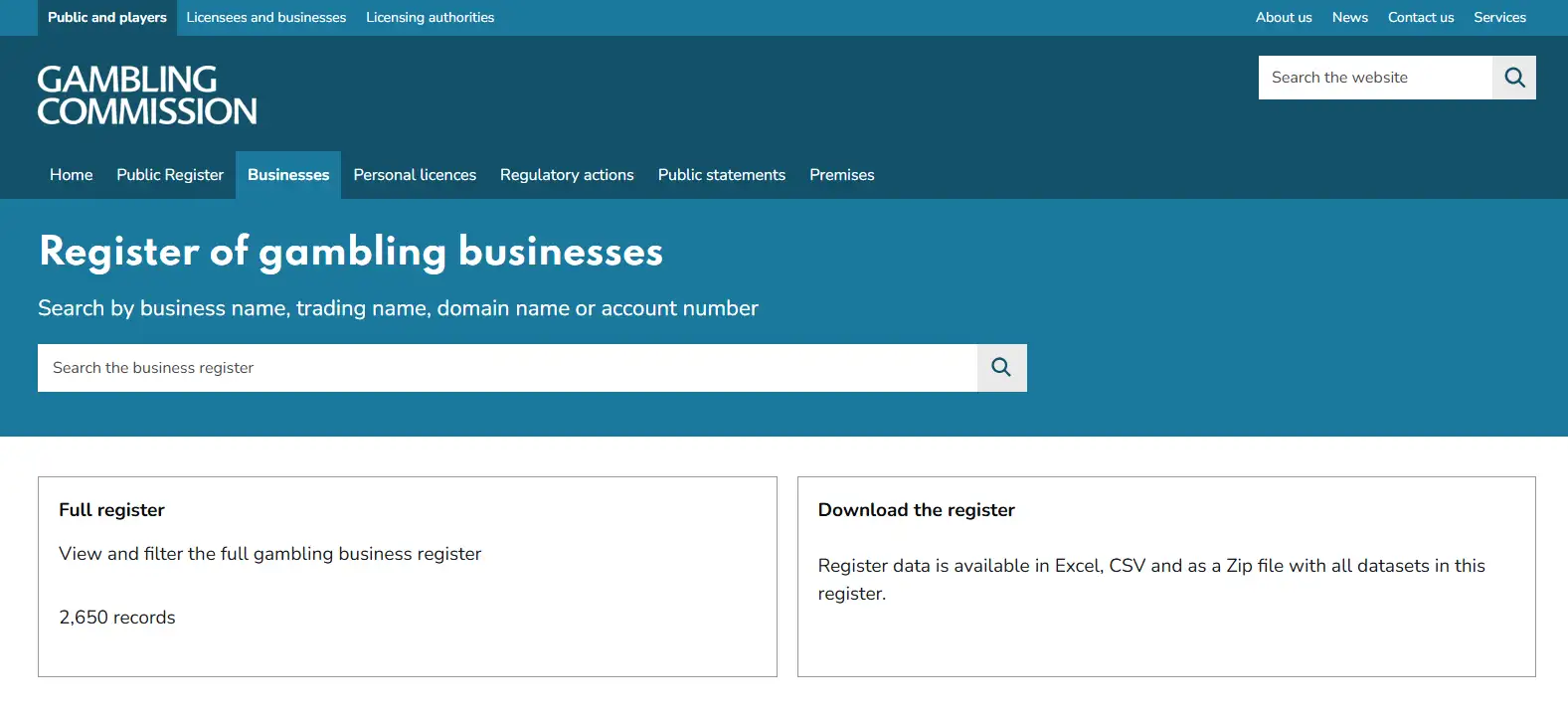
Table of Contents
- Candyland and the UKGC register
- How Candyland appears in the UKGC register
- What Great Britain requires from an online casino
- Candyland’s Curaçao jurisdiction statement
- Great Britain and Northern Ireland use different frameworks
- Can UK residents open a Candyland account?
- What no matching UKGC register entry means
- UKGC-linked protections
- How to check a casino licence
- What UK readers should take from the licence position
- Four questions should stay separate
- What the UKGC dataset result means
- UKGC-linked protections are conditional on applicable licensing
- Why GBP support is not a licence test
- Related Candyland checks
Candyland and the UKGC register
| Question | Current position |
|---|---|
| UKGC licence | Candyland, candyland.casino and SSC Entertainment N.V. do not appear in the UKGC business, trading-name or domain datasets. |
| Great Britain rule | An online casino serving consumers in Great Britain needs the relevant Gambling Commission operating licence. |
| Northern Ireland | Northern Ireland uses a separate gambling-law framework rather than the Great Britain licensing regime. |
| Curaçao | Candyland has stated a Curaçao licensing jurisdiction; Candyland does not state a current CGA licence number or domain certificate. |
How Candyland appears in the UKGC register
The UK Gambling Commission register can be searched by business name, trading name, domain name or account number, and the Commission also publishes downloadable datasets for businesses, trading names, domain names and licences.
The UKGC datasets can be searched by licensed business, trading name and domain. Candyland, candyland.casino and SSC Entertainment N.V. do not produce a matching entry in those datasets.
That means Candyland should not be described as UKGC licensed on the basis of those identifiers. It does not by itself prove that every UK resident is technically blocked from opening an account.
What Great Britain requires from an online casino
The Gambling Commission’s current remote-sector guidance explains that an operating licence allows gambling activities to be provided to customers in Great Britain, and that the remote casino operating licence covers casino games offered through websites, mobile phones and other online services.
UKGC remote casino licensees must state that they are licensed and regulated by the Commission, show their account number and link to their licensed status on the Commission website. A generic licence logo or an overseas licence statement is not a substitute for that UKGC record.
Candyland should therefore not be treated as UKGC licensed, UKGC regulated or covered by UKGC-linked player-protection arrangements.
Candyland’s Curaçao jurisdiction statement
Candyland has stated that it operates under Curaçao licensing jurisdiction. That statement does not provide a current licence number, expiry date or domain certificate from the Curaçao Gaming Authority.
The Curaçao Gaming Authority says a player-facing B2C domain should be associated with a Certificate of Operation seal linking to its certificate platform and identifying the domain, operator and status.
Legacy 8048/JAZ references should not be treated as current proof for candyland.casino. A current authority-issued number or domain certificate is the stronger way to establish the present Curaçao status.
Great Britain and Northern Ireland use different frameworks
Most discussions of “UK gambling law” actually describe Great Britain – England, Scotland and Wales – where the Gambling Commission framework applies. Northern Ireland is different. The Department for Communities states that gambling there is regulated under the Betting, Gaming, Lotteries and Amusements (Northern Ireland) Order 1985, as amended by the 2022 Act, and that broader online-gambling reform has been a separate policy question.
For UK readers, the practical point is geographical: the UKGC requirement applies to Great Britain, while Northern Ireland follows a different framework.
Can UK residents open a Candyland account?
UK registration appears to be supported, and Candyland’s terms do not name the United Kingdom among generally prohibited countries. That can indicate an account route is available, but it does not create a UKGC licence.
For account setup, see Candyland registration. For cashier availability, see Candyland payments.
What no matching UKGC register entry means
No matching register entry under the identifiers above means Candyland should not be presented as holding a current Great Britain operating licence under those identifiers. It does not describe the brand’s legal position in every jurisdiction or prove that the website is technically blocked to every UK visitor.
A working website, GBP support or a successful registration step does not by itself establish UKGC authorisation. In Great Britain, the regulator record remains the relevant check for UKGC licensing.
UKGC-linked protections
UKGC rules attach obligations to licensees. For example, applicable remote licensees must participate in the national multi-operator self-exclusion scheme. Other licence conditions govern how licensed status is displayed and how remote gambling is provided to consumers in Great Britain.
UKGC-linked protections apply only where the operator is covered by the relevant UKGC regime. Do not assume Candyland is covered by GAMSTOP, UK ADR or other UKGC-specific protections.
For support, KYC and practical trust checks, see Candyland safety and complaints.
How to check a casino licence
- Start with the regulator, not a review badge. Search the UKGC register by brand, domain and operator name.
- Check the exact domain. A licence belonging to a different website or company does not automatically cover candyland.casino.
- Check current status. An old account number, expired licence or legacy Curaçao sub-licence reference should not be treated as current authorisation.
- Match the regulator to your location. A Curaçao statement does not replace a Great Britain operating licence when the question is UKGC coverage.
What UK readers should take from the licence position
Candyland does not appear in the UKGC datasets under the brand, domain or SSC Entertainment N.V. identifiers, so it should not be presented as UKGC licensed. Candyland has stated a Curaçao licensing jurisdiction, but Candyland does not state a current CGA licence number or domain certificate. A UK resident may still encounter a working registration route, but that does not change what the UKGC register lists.
For readers in Great Britain, the practical regulatory benchmark is the UKGC public register and the remote operating-licence framework. For Northern Ireland, use the separate local legal framework rather than assuming the Great Britain rules apply identically. For the broader brand assessment, return to the Candyland UK review.
Four questions should stay separate
The Candyland licence question is easier to follow when it is split into four parts. For account access, Candyland currently presents UK registration as available and the published terms do not visibly list the United Kingdom as generally prohibited. Candyland’s own site states that it operates under Curaçao licensing jurisdiction. Great Britain has its own requirement for remote casino operators serving consumers there. Finally, the current UKGC business, trading-name and domain datasets do not contain a matching entry for Candyland, candyland.casino or the cited SSC Entertainment N.V. name.
None of those facts should be substituted for another. Account access does not create a UKGC licence. A Curaçao jurisdiction statement does not create Great Britain authorisation. A UKGC no-hit does not prove that every UK resident is technically blocked from opening the website or completing a form. Together, these points support a precise description of regulatory coverage rather than a whole-UK “legal” or “illegal” label.
What the UKGC dataset result means
UKGC businesses, trading names and domains are searchable regulatory identifiers. No matching entry under the Candyland brand, candyland.casino and the cited operator name means those identifiers should not be used to describe Candyland as holding a current Great Britain operating licence. It describes the register result, not a technical access test.
The limit of the conclusion matters. A website can load, a registration route can be visible and GBP can be supported without those facts establishing UKGC authorisation. Conversely, the lack of a matching record under these identifiers does not by itself describe the legal position in Northern Ireland or every other jurisdiction. The relevant Great Britain rule is that a business providing remote gambling facilities to consumers there needs the appropriate Commission licence regardless of where it is based.
UKGC-linked protections are conditional on applicable licensing
Applicable UKGC remote licensees must participate in the national multi-operator self-exclusion scheme. That is an example of why licence scope matters to a player: regulatory status can determine which local protection framework applies. It should not be phrased as though Candyland is covered by UKGC-linked schemes when the current register does not show a Candyland entry under these identifiers.
The same discipline applies to bonus and payment rules. Great Britain rules for UKGC licensees can be useful benchmarks, but they do not become Candyland-specific terms simply because a UK resident can reach the site. Regulatory requirements and operator terms should be read in parallel, not merged.
Why GBP support is not a licence test
Candyland’s terms define pounds as a supported credit denomination, and Candyland currently presents UK registration as available. Neither fact answers the Great Britain licensing question. Currency support is a product setting and registration is an access question; the regulator record is the separate question used for local authorisation.
Keeping those categories separate is especially important for overseas operators. A site can present GBP and an account form without those features proving that the relevant UKGC operating licence appears in the register.
Related Candyland checks
- Candyland UK review – the wider product and UK-facing decision context.
- Candyland safety – support, KYC and practical trust checks without repeating the legal framework.
- Candyland registration – the account-access details.
- Candyland payments – the cashier context and Great Britain payment-rule distinction.
- Candyland bonus – the 200% offer and the separate UKGC bonus benchmark.
Prepared by the Candyland Casino 2 editorial staff.